
Walking briskly after 40 adds years to your life
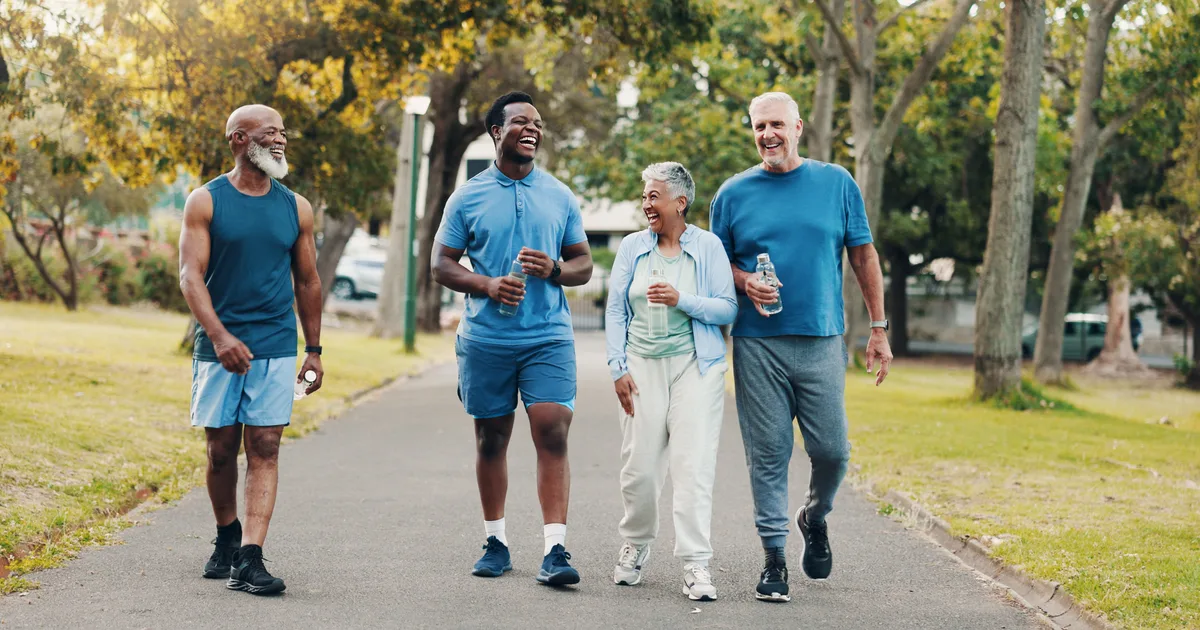
Fifteen brisk minutes a day are linked to 20% lower mortality and three to four extra years of life. Here's what brisk actually means and where to fit it in.
Good news for anyone who has spent half a lifetime saying I just don't enjoy running: you don't have to. Walking — but properly, with a bit of urgency and without stopping at every shop window — already shifts the needle in a way that's genuinely surprising. And the bar is set far lower than you'd imagine.
Fifteen minutes, twenty per cent
A study published in the American Journal of Preventive Medicine followed close to 80,000 adults and found that walking briskly for at least fifteen minutes a day was associated with roughly a 20% reduction in all-cause mortality, with a particularly clear benefit for cardiovascular disease. Fifteen minutes. Less time than you spend deciding what to watch tonight.
Across a week that comes to about 75 minutes: an hour and a quarter spread over seven days. That isn't a training plan, it's a habit.
Three or four years, according to the science
The other striking figure concerns life expectancy: taking up brisk walking from the age of 40 has been associated with gaining between three and four years. It's worth reading that with a cool head, since these are association studies in large populations rather than a personal guarantee. But the direction of the finding is hard to argue with, and the cost of trying is precisely nothing.
So what counts as brisk?
This is where a lot of people kid themselves with the very best intentions. Brisk isn't the after-lunch stroll where you put the world to rights. It's the pace where your breathing gets noticeably heavier, you feel warm within five minutes, and you could hold a conversation — but you couldn't burst into song. If you finish and haven't felt a thing, you were probably strolling. Which is lovely, but it isn't this.
Where those fifteen minutes fit into an ordinary day
- Get off the bus or tube one stop early, there and back.
- Park further away on purpose. Yes, on purpose.
- Turn that afternoon phone call into a walking phone call.
- Go round the block after lunch, at a deliberately hurried pace.
- Run your errands on foot instead of by car, even if it takes longer.
- If you have a dog, let them pick the route and you set the pace.
The exercise that changes your life isn't the hardest one, it's the one you'll also do tomorrow.
The Victoris team
The first step is the one that pays best
Here's the nuance we like most: the big leap isn't between training a lot and training an enormous amount, it's between doing nothing and doing a little. Anyone who moves from a sedentary life to moderate activity collects most of the benefit. What comes afterwards still adds up, of course, but with diminishing returns. In other words, the person doing nothing today is, paradoxically, sitting on the best investment available.
And if you end up hooked
That's usually what happens. You start with fifteen minutes because you read it somewhere, three weeks later it's twenty-five because you fancy it, and one day you catch yourself working out whether there's time to reach the big park. That's the moment walking stops being a prescription and becomes time that belongs to you. And if those minutes start counting towards your Victoris challenge, better still.
Turn those kilometres
into a medal.
Sign up for a Victoris challenge and every training session brings you closer to the medal delivered to your door.
More from the Victoris Diary
 Vida saludable
Coffee before training: the dose that actually works
A review of 48 trials puts a number on caffeine for athletes: 4 to 6 mg per kilo. We translate that into real cups and explain why it might not suit you.
 Vida saludable
Sleeping well: the invisible training that pays off most
Sleep repairs muscles, balances hormones and fine-tunes your technique while you rest. Here is why sleeping well outperforms any supplement, and how to improve your sleep hygiene.
 Vida saludable
Five summer meals to recover without turning on the oven
Real quantities, no guesswork, and a formula for building your own plate from whatever's in the fridge. Because cooking anything hot in August is unthinkable.